A Ritual of Liminality
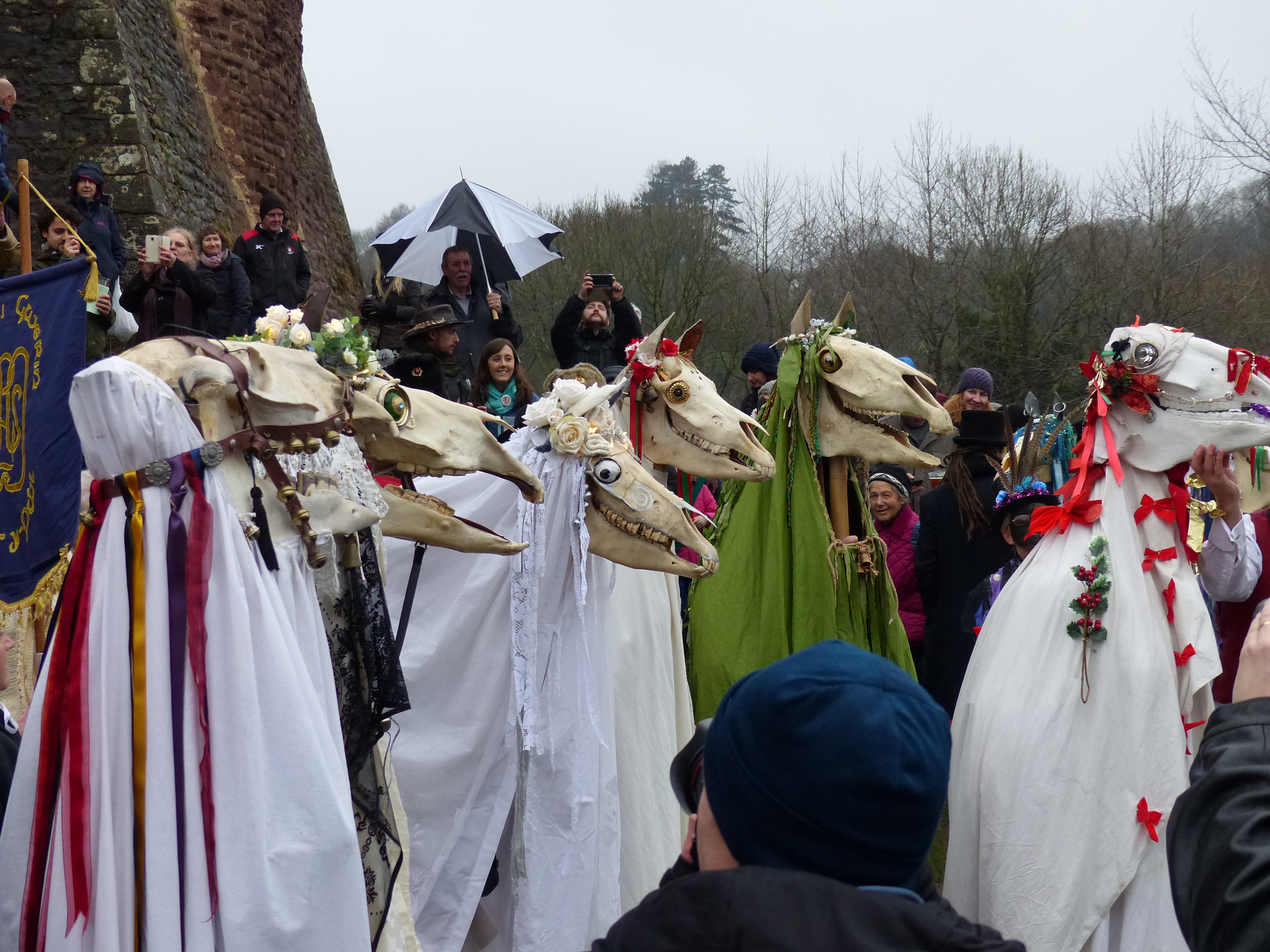
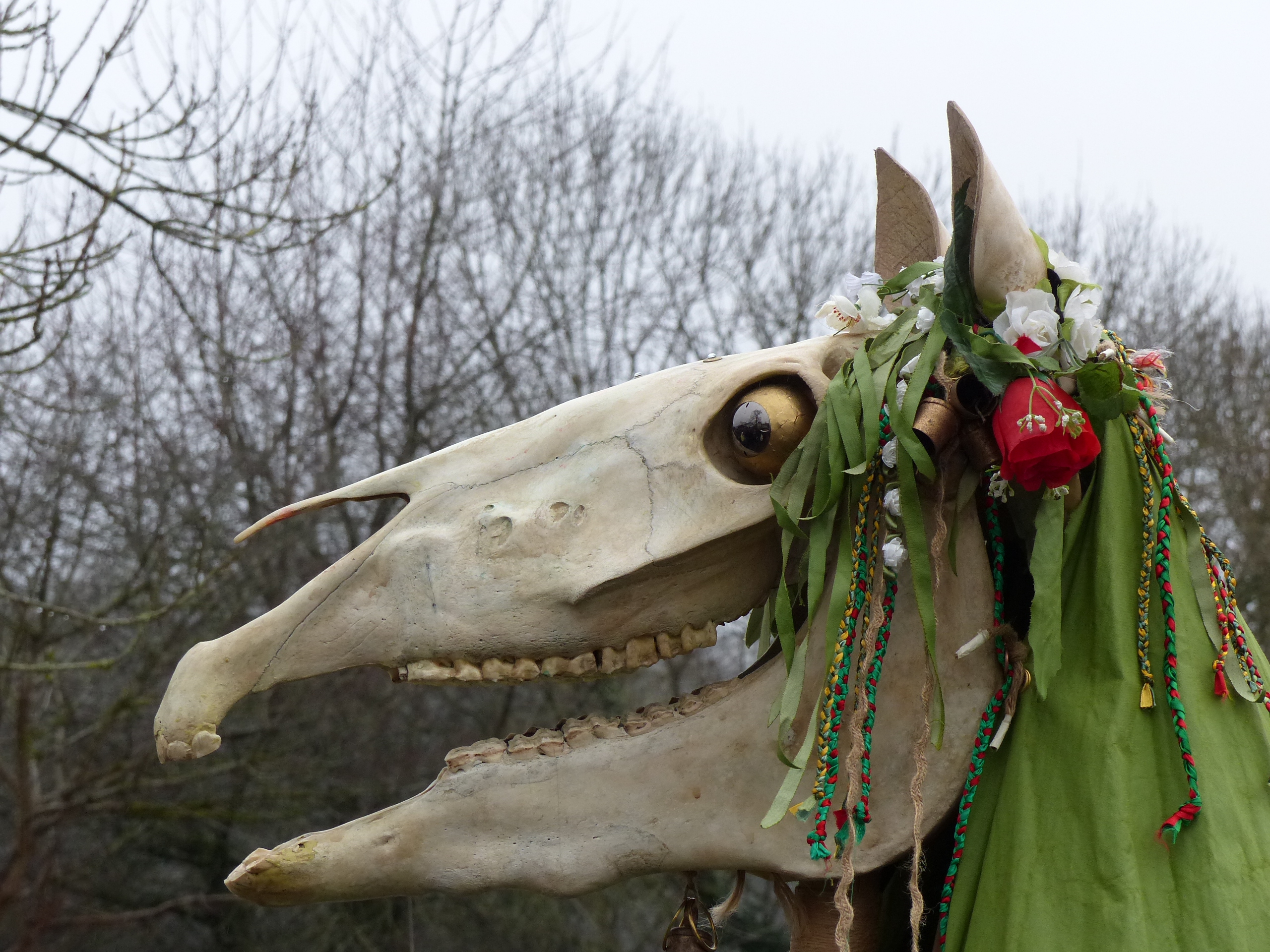
That the Mari Lwyd is a ritual of liminality is clear. Liminal space is the place between two realms of reality and can be physical, psychological or time-bound. The Mari occurs in all three spaces.
- It is physically in a doorway — between inside and out. Between the revellers and the householders.
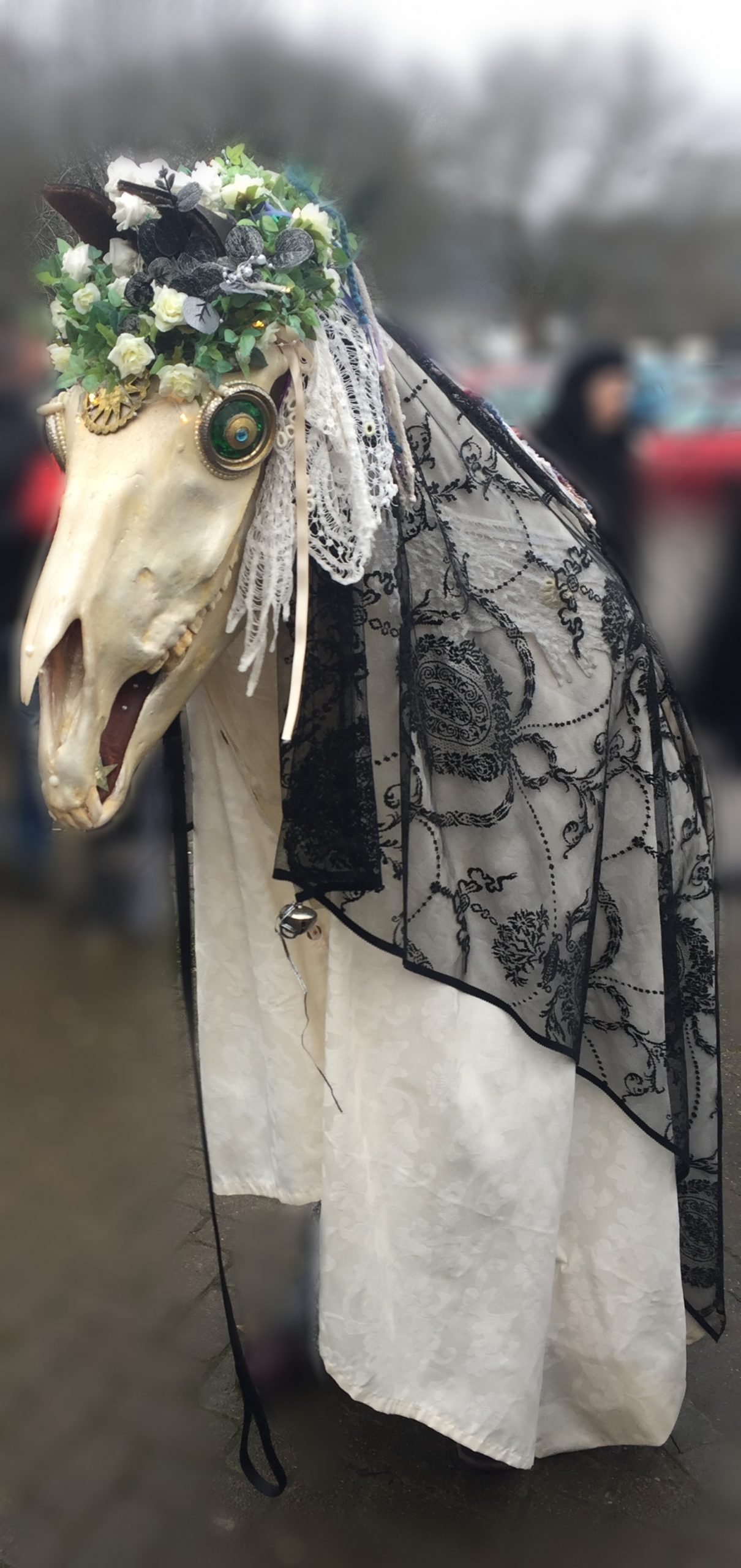
- It is psychologically between joy and terror — the merriment of the party and the grotesque form of an undead horse. Indeed it is between life and death.
- It is in the liminal time between years. Whilst there is a broad timeframe for Mari to appear all are linked with the New Year in some way, be it the secular, Celtic, or even Julian calendar New Year. More broadly it can be seen as a time of seasonal transition.
A clear boundary is created in multiple senses that is plain for all to see. An us and a them. Insiders and outsiders. Those with command over death, and those afraid of its earthly symbolism.
The tension is intensified with the challenge and response of the participants. Those familiar with traditional initiatory rites might well consider the Mari Lwyd in light of their own experiences and find some enlightenment as to the ritual purpose of the hooded horse.
In the end it is the horse which straddles both realms, a trait which sits well with its mythical associations. In the first branch of the Mabinogi, Rhiannon is first introduced to us as a being of another realm riding a shining white horse. She later acts as horse herself carrying guests to court and in the third branch is whisked away to the otherworld. Rhiannon herself is caught in a liminal space — between her role as an earthly wife and her origin as an otherworldly being.
Whilst considering the Mabinogi one cannot help but wonder about the severed head associations too, with Bran’s head buried in London as a protection. Interestingly discoveries of foundation burials of horses’ heads are not uncommon in Celtic regions, including examples in Wales. Most often the heads are found buried under thresholds or the hearth – both liminal space — although on occasions they have even been found at each corner of a building. Other mythological associations include Epona, the trojan horse, and the Grim Reaper riding his white horse. Welsh folk tale collections abound with stories of horses and mysterious riders which transcend the boundaries between the ordinary and the supernatural. Sometimes the horse acts to warn the living, sometimes themselves an apparition. Oftentimes the tales combine horses and crossroads layering the symbolism and bringing us back to themes of liminality.
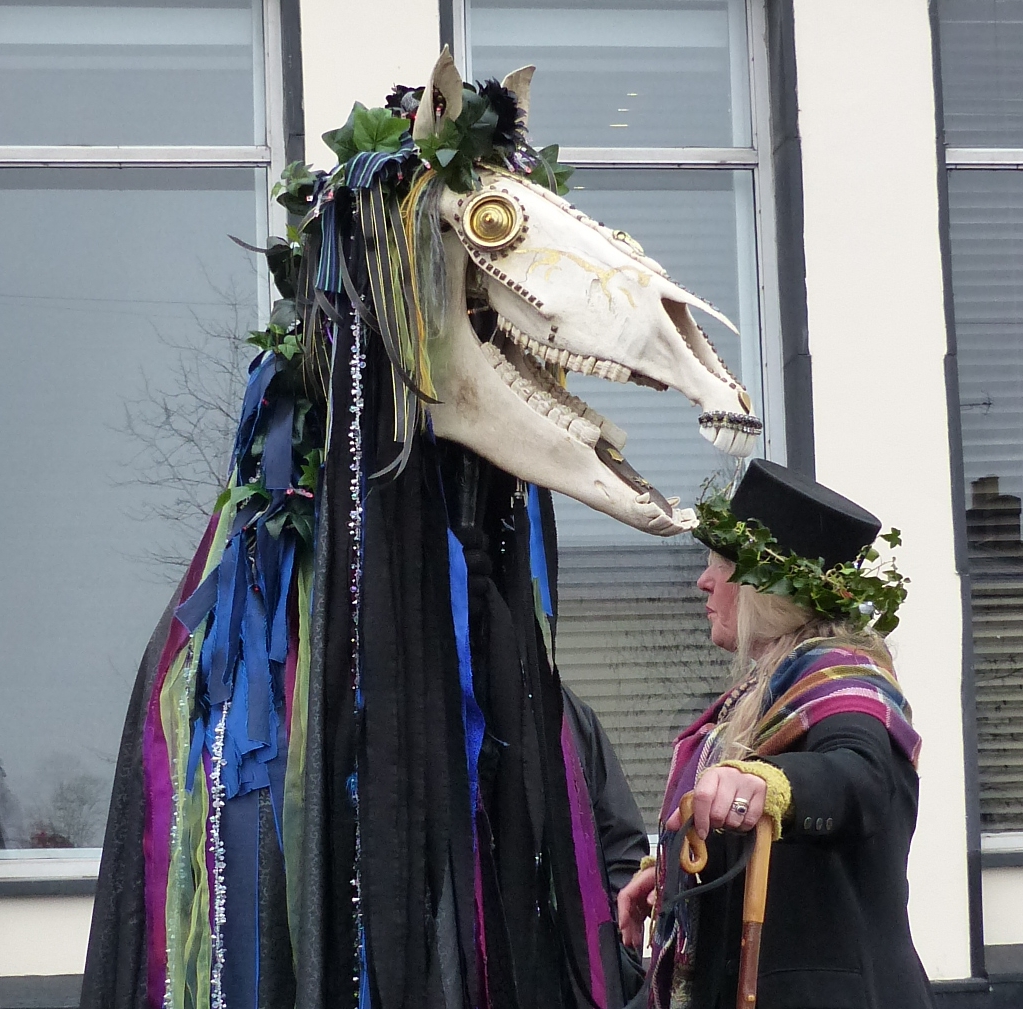
The horse is a symbol of strength — and yet it is domestic. Wild horses are found in prehistoric cave paintings dating to around 30,000BC. By 2000BC they had become a form of transportation, with evidence of the earliest chariot burials dating from this period. The horse’s power is used toward assisting its master to cultivate the land, leading to associations of sovereignty. Its manure, prized amongst gardeners, is just one of the reason for the association of the horse and fertility.
So in the Mari Lwyd ritual we find complex symbolic interplays which come together in an unusual form of first-footing. Even if the precise meaning of the practice are hidden from sight, just a cursory consideration of horse symbolism can provide insights which transform the Mari Lwyd from a slightly odd Welsh custom to a powerful and transforming ritual.
Roots – Ancient, Modern, or Both?
It is beyond the scope of a short article such as this to fully explore the origins of this tradition. Certainly there is no consensus of opinion, with passionate arguments for it being an ancient pagan tradition stamped out by the church, and for it being a modern creation (perhaps recreation) which gained popularity with the rise of Celtic Nationalism in the 18th Century.
What we do know is that the first published account was in 1798 by J Evans (in A tour through parts of North Wales), and prior to this no record is made of the custom.
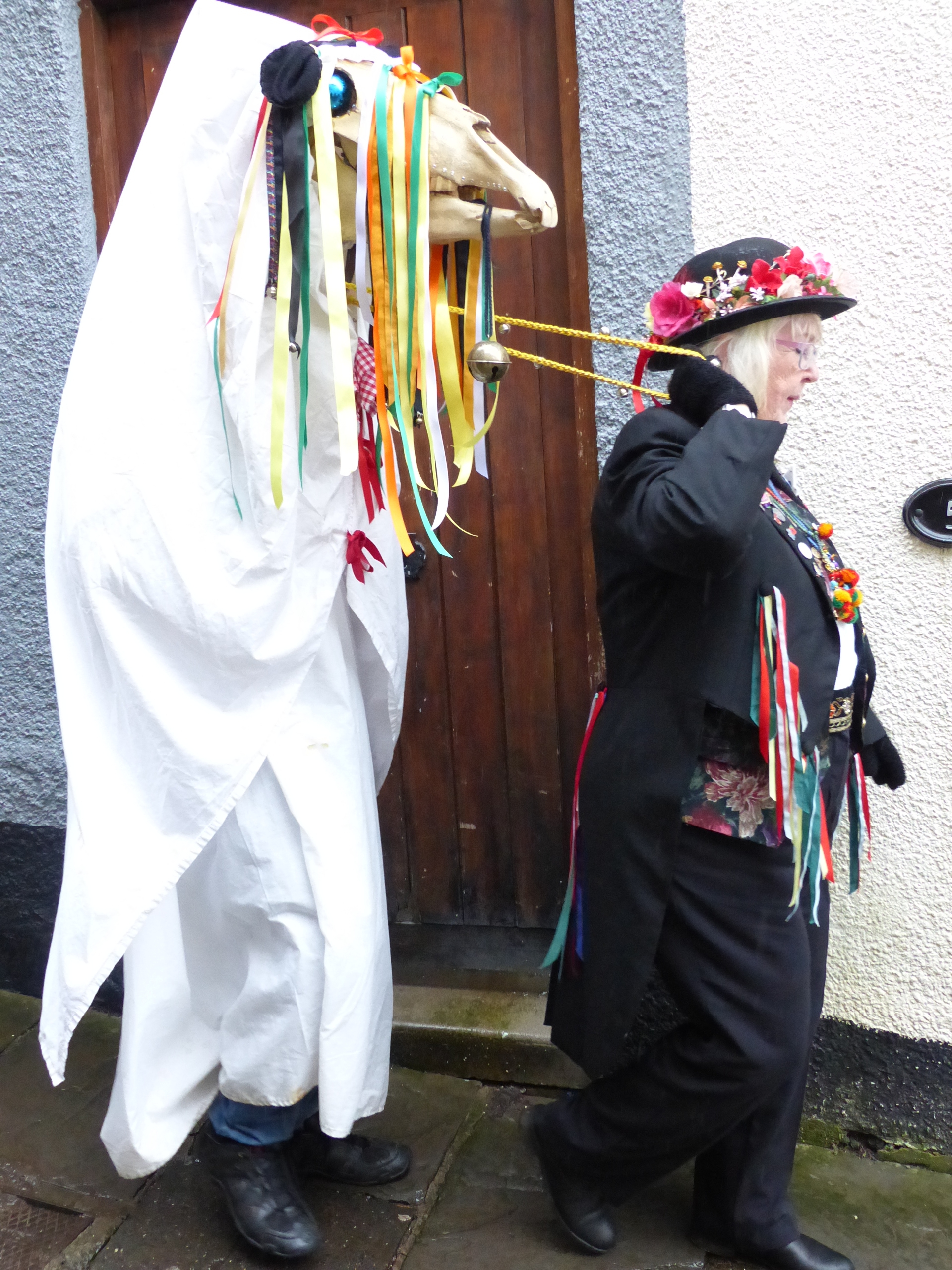
A man on new year’s day, dressing himself in blankets and other trappings, with a factitious head like a horse, and a party attending him, knocking for admittance, this obtained, he runs about the room with an uncommon frightful noise, which the company quit in real or pretended fright; they soon recover, and by reciting a verse of some cowydd, or, in default, paying a small gratuity, they gain admission.
Even if there is scant recorded evidence of a continual tradition then there are clear echos of a distant past. There are, for example, clear links with ancient Horse Queen Cults, and with traditional horse goddesses such as Epona, Rhiannon or Macha. In this respect it has much in common with other horse rituals found in Celtic regions at this time of year. Láir Bhán, accompanied by the messengers of Muck Olla in Ireland, reinforce the imagery of death and the underworld whilst the custom of Laare Vane in the Isle of Mann has a similar structure as a first footing tradition.
Interestingly the counter point of the year, Beltaine also has strong equine associations. Obby Oss customs form a central part of modern May Day celebrations. Their expressions are much more stylised and evoke joy and laughter — for example the world-famous Padstow Obby Oss.
A second echo of the past is the theme of a hero barred from a feast, leading to an exchange of banter. This is found in Celtic literature, such as the Welsh tale Culhwch and Olwen, and whilst not evidence of a direct unbroken tradition from medieval times, it is hard to believe that there is no link. There are too many similarities in the various threads to discard them entirely. Perhaps the most compelling explanation is one of a relatively modern origin utilising older wisdom skilfully weaved together.
The exact origins will probably always remain unclear. The Mari Lwyd ritual we experience today is most likely a resurgent ritual, but one whose roots reach down into the rich cultural traditions of our Celtic ancestors. Like all strong traditions it continues to grow and develop as each year passes. Whilst some Mari are performances, given almost as museum pieces, the most traditional are living traditions which evolve each year. New verses of the pwnco are created on the spot, some living on to future years, and some just occurring in the moment — themselves an example of a liminal space created within the ritual.
A final thought. Once Mari has chased away unwanted spirts from the darkest recesses of the year, bestowed protection and fertility on the homes of the village, what then? What of an undead horse left to wander freely amongst a community without legitimate employment? No, she too must be frightened away, sent back, and the nails on the coffin once more (metaphorically) secured.
None can look out and bear that sight,
None can bear that shock.
The Mari’s shadow is too bright,
Her brilliance is too black.
None can bear that terror
When the pendulum swings back
Of the stiff and stuffed and stifled thing
Gleaming in the sack.
Midnight. Midnight. Midnight. Midnight.
Hark at the hands of the clock.
Links and Further Reading: